Rising Emissions, Depleting Water and Vanishing Land—UN Scientists:
AI Is Threatening Natural Resources for Billions

A groundbreaking investigation published by the United Nations University (UNU) warns that the global expansion of artificial intelligence (AI) is creating an unprecedented strain on natural resources, escalating far beyond carbon emissions.
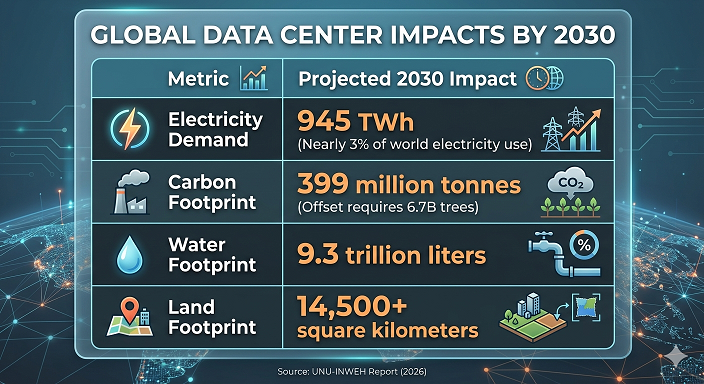
According to the UNU report, “Environmental Cost of AI’s Energy Use: Carbon, Water and Land Footprints,” global data centers powering AI are projected to consume an estimated 945 terawatt-hours (TWh) of electricity by 2030. This projected power use is nearly triple the combined annual consumption of Pakistan, Bangladesh, and Nigeria—countries home to over 650 million people.
Published by the UNU Institute for Water, Environment and Health (UNU-INWEH), the study expands the evaluation of AI sustainability beyond greenhouse gases to quantify its massive water and land impacts.
Hidden Environmental Trade-Offs
UN scientists argue that evaluating AI through carbon metrics alone creates a dangerous blind spot. While switching power sources from coal to bioenergy can slash carbon emissions by 70%, it simultaneously increases the associated water footprint more than 30-fold and the land footprint 100-fold.

“What surprised us most is how often the choices that look greenest from a carbon perspective end up worse for water or for land,” said Dr. Miriam Aczel, the report’s lead author. “Low-carbon” is not automatically “low-water” or “low-land.”
By 2030, AI’s global water footprint is projected to reach 9.3 trillion liters, matching the basic annual domestic water needs of 1.3 billion people in Sub-Saharan Africa. Meanwhile, its land footprint will exceed 14,500 square kilometers—twice the size of the Jakarta metropolitan area.
While public scrutiny initially focused on the immense energy required to train large language models, the report reveals that 80 to 90% of AI’s energy consumption now occurs during “inference”—the execution of everyday user prompts. ChatGPT alone processes roughly 2.5 billion queries daily, translating to 383 gigawatt-hours (GWh) of electricity per year.
Furthermore, the emergence of AI-generated media is intensifying the resource drain. A conversational query requires 200 times more energy than standard text classification, while generating an image uses 1,450 times more. A single complex AI-generated video can draw enough electricity to run a 10-watt LED bulb for 42 hours and consumes 4.1 liters of water.
The report invokes the Jevons Paradox, or rebound effect, noting that as AI becomes more efficient and cheaper, overall usage surges, completely erasing per-query conservation gains.
A Deepening Digital and Resource Divide
The investigation highlights a severe global asymmetry. Over 90% of AI-specialized cloud computing capacity is concentrated in just two countries—the United States and China—leaving more than 150 nations without sovereign compute infrastructure.
Yet, the localized environmental burdens fall heavily on regions capturing few of the benefits. Data centers are already straining grids and water reserves in places like Ireland, Mexico, and Uruguay. Upstream mineral extraction and a projected 2.5 million tonnes of annual electronic waste by 2030 continue to impact low-income economies.
“This report is not a case against artificial intelligence,” emphasized Professor Kaveh Madani, Director of UNU-INWEH and the 2026 Stockholm Water Prize Laureate. “It is a call for using it responsibly… We have a narrow window to ensure that the backbone of the technological revolution of our era develops within planetary limits.”
