Falcons, Freedom, and the Spirit of the Steppe: East Kazakhstan’s Falconry Festival Revives Ancient Traditions

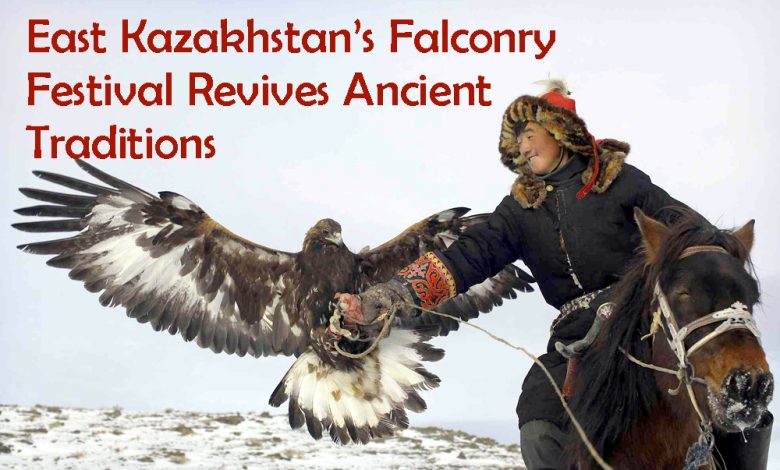
The fifth International Falconry Festival took flight this month in East Kazakhstan, uniting masters of the ancient art and guardians of steppe heritage from seven countries.
A Festival That Brings the Steppe to Life
Held in the Ulan district near Bozanbay village, the event—known locally as Shygys Salburyny—gathered over 100 participants, including falconers and cultural ambassadors from Kazakhstan, Spain, Hungary, Russia, Mongolia, China, and Kyrgyzstan.
Shygys Salburyny celebrates nomadic civilization, reviving traditional crafts, ancestral songs, and sacred rituals, while golden eagles once again soar above the endless plains. Every gesture, from the flight of an eagle to the rhythm of a drum, echoes respect for the harmony between humans and nature—a living bond with the past.

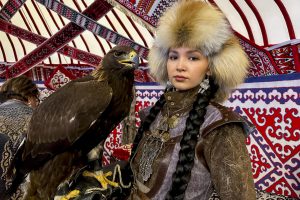
‘Berkutchi’ and Their Golden Eagles: Keepers of the Sky
For centuries, the golden eagle has ruled the Kazakh skies—its strength and freedom inspiring the art of sayat, or hunting with birds of prey. From this practice emerged the berkutchi, a revered brotherhood of falconers.
A berkutchi is more than a hunter; he is a student of the wind, a reader of nature’s pulse. The bond between falconer and eagle cannot be commanded—it must be earned through patience, trust, and respect.
Historically, golden eagles ensured survival during the harsh steppe winters, providing both food and feathers. Over time, sayat evolved from necessity into a symbol of courage, wisdom, and balance. The true berkutchi, like the batyr warrior, was honored for his calm and nobility.
Training a young eagle is an art of devotion. Eaglets are taken from the wild and gradually trained to trust their handler’s hand and voice. Before each flight, the falconer dons the iyanga (a protective glove) and removes the tomaga (leather hood) after a quiet prayer—reminding all that hunting is a sacred dialogue, not a conquest.
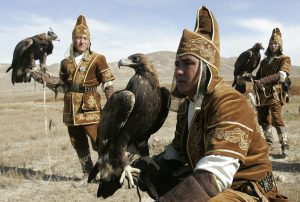
Sayat in the Modern Age
Though practiced across Kazakhstan, East Kazakhstan remains the heartland of sayat.
“Not every bird obeys instantly,” said Daniyar Nurbek, the festival’s chief judge, in an interview with The Times of Central Asia. “It’s not about force but understanding—there must be a deep spiritual bond between hunter and eagle.”
Young Learners and Masters of the Sky
This year’s festival drew both seasoned falconers and young learners. Among them, seven-year-old Abdurashid Mamyrkhan stood out. His father, Mamyrkhan Manayuly, proudly shared, “This isn’t just hunting—it’s our heritage. By teaching my son, I’m passing down respect for nature and our ancestors.”
Foreign participants echoed similar admiration. Hungarian falconer Gergely László Bodis said he felt “the breath of antiquity” in the Kazakh steppes.
“In Hungary, we also practice falconry, but here it feels like a living ritual, part of the soul,” he noted.
Russian participant Alexander Malakhov described the event as “a philosophy rather than a competition.”
“The essence lies not in technique, but in respect. Kazakhstan inspires reflection—its people, culture, and nature are inseparable,” he said.
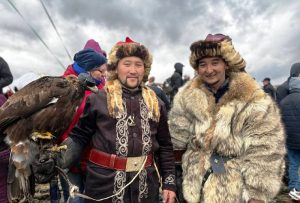
From Spain, Luis Guijarro Panadero observed: “In Spain, falconry is sport. Here, it’s a cultural code.”
A Living Ethno-Village
Beyond the competitions, visitors experienced a vivid cultural showcase. At Burkit Tobe, a traditional village of 40 yurts recreated scenes of ancient Kazakh life—weddings, birth rituals, and the symbolic act of “adding oil to the fire.” Each yurt served as a miniature museum, honoring the artistry of nomadic existence.
The Spirit of Competition
Alongside falconry displays, the festival hosted shooting and equestrian events. Serikbol Oktyabr won the shooting contest, emphasizing the inner strength it demands: “These trials test not just muscle, but spirit. Through them, we renew our ancestral pride.”
Aqzhan Merke triumphed in horseback riding, calling the sport “a vital part of our national identity.”
Falcons, hawks, and eagles soared and dove across the skies, thrilling spectators. Baitbay Omirkhan from Almaty claimed victory in both the eagle and hawk contests, while Kenzhetaev Erlan from the Akmola region took first place in the falcon category.
“The falcon is a noble bird,” Omirkhan said. “To work with it is both an honor and a duty. This year, I felt the festival’s spirit more deeply—it’s not just competition, it’s unity.”
Kenzhetaev agreed: “This is my third Shygys Salburyny, and every year the bar rises higher. Such festivals are essential for keeping our heritage alive.”
As one participant reflected:
“As long as the golden eagle soars over the steppe, as long as fathers pass the tomaga and iyanga to their sons, as long as Kazakh songs are sung—our culture will endure.”
By Yulia Chernyavskaya