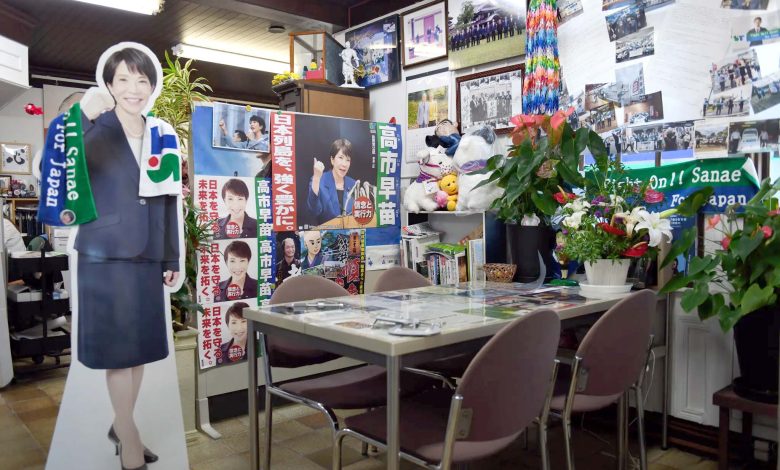
As a young woman in the late 1970s, Sanae Takaichi commuted six hours a day by bus and train from her parents’ home in western Japan to attend university. She was a fan of heavy metal music and Kawasaki motorcycles who yearned to move out. But her mother insisted at first that she stay home, forbidding her from living in a boardinghouse before marriage.
On Tuesday, Ms. Takaichi won election as Japan’s prime minister, the first woman to do so in the nation’s history. It was the pinnacle of an improbable rise in politics and a milestone in a country where women have long struggled for influence.
Ms. Takaichi with other Liberal Democratic Party leaders in Tokyo on Tuesday.Credit…Jiji Press, via Agence France-Presse — Getty Images
Ms. Takaichi, 64, who grew up near the ancient Japanese capital of Nara, defies easy labels. She once spoke bluntly about the challenges of working in politics as a woman in Japan, yet she is now the leader of the traditionalist, male-dominated Liberal Democratic Party. She has expressed concern about Japan’s reliance on the United States, but has also said she hopes to work closely with President Trump. She is an amateur drummer who idolizes bands like Iron Maiden and Deep Purple, yet she also wears blue suits to pay homage to her other hero, the former British prime minister Margaret Thatcher.

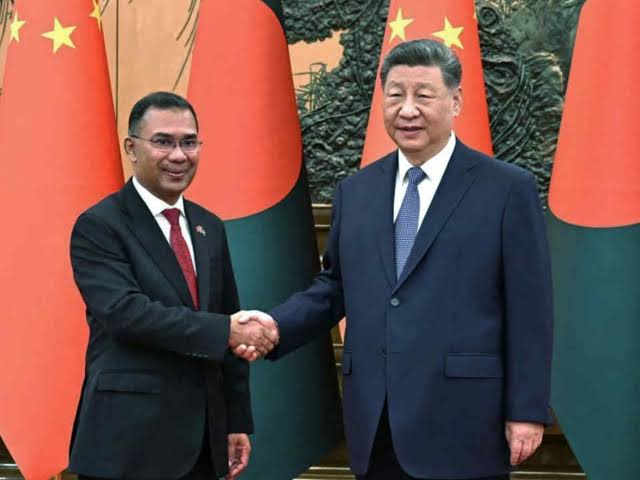
Ms. Takaichi, a protégé of Shinzo Abe, Japan’s longest-serving prime minister, who was assassinated in 2022, is expected to move Japan farther to the right, responding to a recent populist wave that bears some similarities to Mr. Trump’s MAGA movement. She has embraced hawkish policies on China; pushed the message that “Japan is back”; played down Japan’s atrocities during World War II; and promised to more strictly regulate immigration and tourism.
“She wants to make Japan strong and prosperous for the people of Japan and for the world,” said Yoshiko Sakurai, a prominent journalist and activist who has supported Ms. Takaichi. “She is open to the outside world. But she also understands that we have to be really good Japanese. We have to know our own culture, traditions, philosophy and history.”
Ms. Takaichi will face her biggest test yet as she deals with fresh uncertainty about Japan’s military and economic alliance with the United States. She is expected to meet next week in Tokyo with Mr. Trump, who has rattled Japanese officials with tariffs and suggestions that the country should pay more for the presence of American troops in the region.
While many Japanese politicians come from wealthy, elite circles, Ms. Takaichi grew up in humble circumstances in Nara Prefecture, an area teeming with temples, shrines, dense forests and rolling green hills. Her mother worked for the police department, and her father worked at a car parts maker.
Kashihara City in Nara, where Ms. Takaichi spent her childhood.Credit…Noriko Hayashi for The New York Times
Motoko Shimada, a childhood friend of Ms. Takaichi’s, recalled her pigtailed classmate sharing homemade onigiri, or rice balls, and rolled omelets with students who had forgotten their lunchboxes on a school trip.
“She was very smiley and very reserved,” Ms. Shimada said. “She didn’t have this strong-woman image. But she was able to notice when someone was not blending in well or struggling, and she was able to help them.”
From a young age, Ms. Takaichi seemed aware of the pressures facing Japanese women. Her mother told her to be a “crimson rose,” Ms. Takaichi recalled in a 2024 biography by Eiji Ohshita, asking her to “retain feminine grace while possessing the thorns to confront wrongdoing.”
Her parents pressured her to attend Kobe University, a state school about 50 miles northwest of her hometown, even though she had won admission to elite private institutions in Tokyo. They felt their daughter did not need a university education because she was a girl, Ms. Takaichi has said in interviews, and they wanted to save up to support her younger brother. (Ms. Takaichi declined, through a representative, to be interviewed for this article.)
After graduation, Ms. Takaichi attended the Matsushita Institute of Government and Management, a renowned training ground for young politicians and business leaders. In the late 1980s, she took an interest in the United States, Japan’s chief economic competitor at the time, securing an internship in the office of former Rep. Patricia Schroeder of Colorado, a Democrat and ardent feminist.
Ms. Takaichi had been moved by Ms. Schroeder’s tearful speech in 1987 announcing she would not run for president. Ms. Takaichi sent Ms. Schroeder a telegram, encouraging her to run again someday and offering her help.
In Washington, Ms. Takaichi was an energetic presence, peppering aides with questions about the inner workings of Congress and American foreign policy — and developing a love of peanut butter. There was no hint of her conservative views on defense or social issues at the time, said Andrea Camp, a former aide to Ms. Schroeder.
When she returned to Japan, Ms. Takaichi worked as an author and a television personality, developing a reputation as a pugnacious debater. In 1993, she began her political career, winning election to Parliament as an independent from Nara on a platform of political reform. Her father put his retirement savings toward her campaign.
In the Diet, Japan’s Parliament, Ms. Takaichi soon discovered the isolation of being a woman in politics. Her male colleagues were sometimes dismissive, she recalled, and they often conducted business at saunas and social clubs, where it wasn’t feasible to meet with female lawmakers.
A woman wearing a garland of flowers smiles and raisers her arms in the air, surrounded by men doing the same.