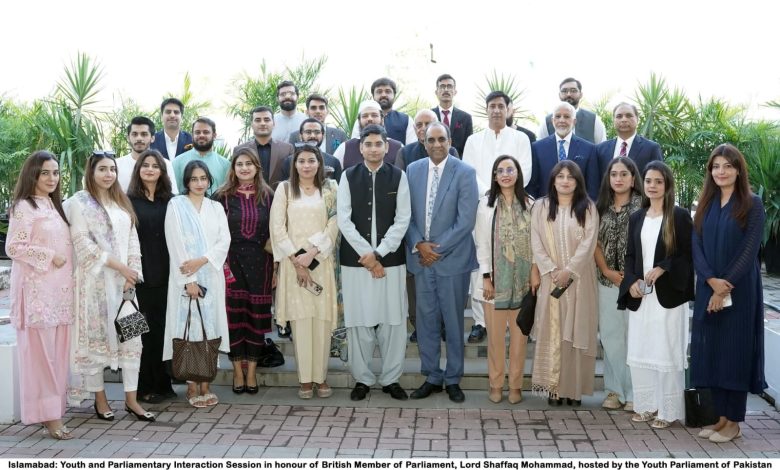
Islamabad — In a city often defined by its politics of the past, a new generation of Pakistanis is learning the language of leadership — diplomacy, dialogue, and democratic responsibility. That was the message resonating through a vibrant evening in Islamabad, where the Youth Parliament of Pakistan hosted Lord Shaffaq Mohammed, a member of the British Parliament, in a reception celebrating cross-cultural engagement and youth empowerment.
Organized under the stewardship of President Ubaid-ur-Rehman Qureshi and Secretary-General Hammad Malik, the event drew together political figures, journalists, religious leaders, and youth representatives — a convergence that reflected the very spirit of participatory democracy the organization seeks to promote.
Lord Shaffaq Mohammed, a Liberal Democrat peer known for his advocacy on integration and inter-community harmony in the UK, spoke candidly about the power of young voices in shaping modern democracies. “When young people engage with conviction, they bring renewal to political culture,” he said. “Stronger ties between Pakistan and the United Kingdom will emerge not from governments alone, but through shared values fostered by youth on both sides.”
Among the guests was MNA Sehar Kamran, who underlined the political maturity emerging among Pakistan’s youth and particularly its young women. “They are no longer passive observers of democracy,” she noted, “but active partners in its evolution.”
The event also drew attention to Pakistan’s evolving media and civic landscape. Mian Mehtab Khan, Chairman of Ausaf and ABN Group, reflected on how journalism and youth activism could together reshape Pakistan’s democratic narrative. “A responsible media and engaged youth are the twin pillars of a healthy democracy,” he remarked, pledging continued support from his media network for youth-led initiatives.
Spiritual leader Sahibzada Saad Jameel-ur-Rehman of Eidgah Sharif took the discussion to a moral plane, urging the next generation to pair leadership with ethics and compassion. “Without moral vision,” he said, “politics becomes machinery; leadership must remain human.”
The Youth Parliament’s recent delegation to the United Kingdom — represented by Bakhtawar Mehmood and Sidra Akhtar — shared reflections from their visit to the British Parliament and House of Lords. Their accounts painted a portrait of inspiration, of young Pakistanis witnessing democratic traditions at work and returning home determined to build their own.
Executive Member Faisal Jamshed described the initiative as “a bridge between aspiration and leadership,” emphasizing that the Youth Parliament’s model of civic training and international exposure is “not symbolic but strategic — it builds the skills that democracy demands.”
For President Ubaid-ur-Rehman Qureshi, the mission is simple yet profound: to put young Pakistanis at the decision-making table. “Youth must not be spectators to the nation’s future,” he said in closing remarks, “they must be its authors.”