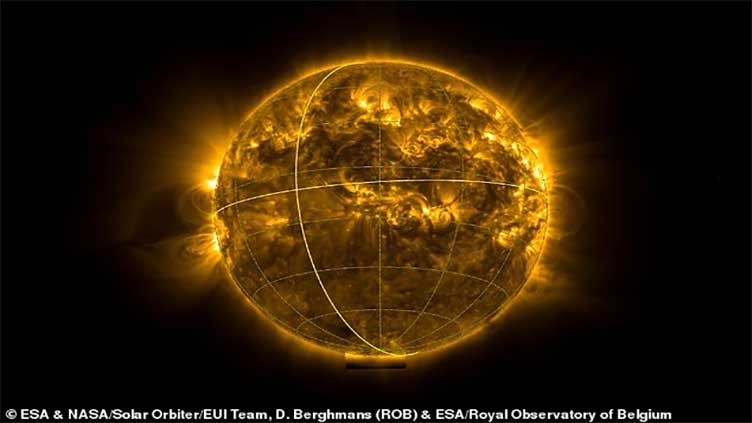
ISLAMABAD: The European Space Agency (ESA) has achieved a remarkable milestone by capturing the first-ever images of the sun’s south pole.
Until now, all images of the sun have been taken from the flat plane where planets orbit, missing the polar regions entirely.
By tilting its orbit 17 degrees below the equator, ESA’s Solar Orbiter revealed a previously unseen view of our star’s hidden south pole.
The probe will tilt further soon, promising even clearer images and more groundbreaking discoveries.


Revolutionary Imaging Instruments
Solar Orbiter employed three advanced instruments to study the sun’s south pole in unprecedented detail.
The Polarimetric and Helioseismic Imager (PHI) mapped the surface magnetic fields using visible light.
The Extreme Ultraviolet Imager (EUI) captured ultraviolet light revealing million-degree charged gases in the sun’s outer atmosphere.
The Spectral Imaging of the Coronal Environment (SPICE) analyzed different layers of the sun’s atmosphere by detecting light from various temperatures of charged gas.
Unlocking the Sun’s Magnetic Mysteries
These new images help scientists better understand the sun’s magnetic poles, which flip roughly every 11 years in the solar cycle.
Currently, the sun’s south pole shows a rare state of magnetic disarray, with both north and south magnetic fields present simultaneously.
This temporary phenomenon happens during solar maximum, a period of heightened solar activity that can affect
Earth’s electronics and communications.
Researchers hope that by studying these polar magnetic flows, they can improve predictions of solar maximum events and the sun’s overall activity cycle.
This historic observation fills a crucial gap in solar research and opens new avenues for understanding our star’s behavior and its impact on Earth’s environment.