
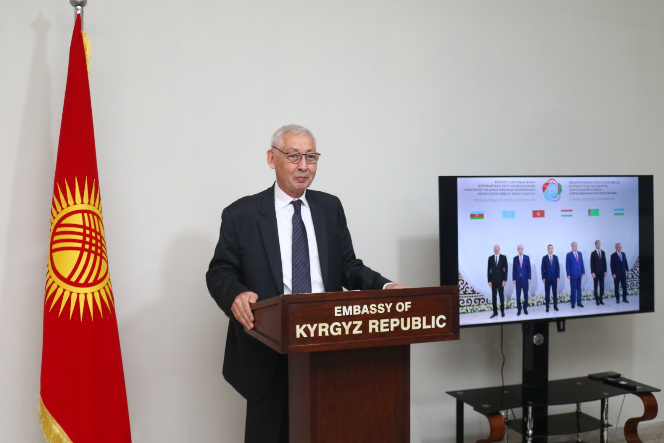
ISLAMABAD: The Ambassador of the Kyrgyz Republic, while briefing representatives of the mass media, highlighted the outcomes of the informal Consultative Meeting of the Heads of State of Central Asia and the Republic of Azerbaijan, held on **July 31 in Cholpon-Ata, Kyrgyz Republic**, describing the summit as a historic turning point in the region’s political, economic and strategic cooperation.
The Ambassador said the consultative meetings, initiated in 2018 among Kazakhstan, Kyrgyzstan, Tajikistan, Turkmenistan and Uzbekistan, were established to strengthen regional cooperation and promote a peaceful, stable and united Central Asia. He termed Azerbaijan’s participation as a full member for the first time as the defining development of the latest summit.
He said growing mutual trust among Central Asian states had created a new environment for regional cooperation, particularly following the resolution of long-standing border issues between Kyrgyzstan, Uzbekistan and Tajikistan. He noted that the settlement of these disputes had transformed borders from barriers into bridges for friendship, trade and connectivity.
The Ambassador highlighted the region’s growing economic and geopolitical significance, noting that Central Asia and Azerbaijan together represent a market of around **85 million people**, with a combined gross regional product exceeding **$600 billion**. He said the region was emerging as an important strategic bridge between Europe and Asia and was increasingly engaging major global partners through various **C5+1** dialogue mechanisms.
Discussing Kyrgyzstan’s international role, the Ambassador said the country had been elected as a **non-permanent member of the UN Security Council for the 2027–2028 term** and expressed appreciation to Pakistan for supporting Kyrgyzstan during the election process.
He said Kyrgyzstan would use its UN Security Council membership to promote international peace, conflict mediation, peacebuilding, disarmament and non-proliferation, while advocating the interests of developing, landlocked and least-developed countries. He also emphasized food and energy security, the protection of women and children in conflict zones, Afghanistan’s stability and greater multilateral cooperation.
On regional connectivity, the Ambassador placed particular emphasis on the **China–Kyrgyzstan–Uzbekistan railway** and the **Kambarata-1 Hydropower Project**. He said the 532-kilometre railway would connect Kashgar in China with Andijan in Uzbekistan through Kyrgyzstan and would significantly strengthen trade connectivity between China, Central Asia and Europe.
According to the Ambassador, the Kambarata-1 project would have a generation capacity of **1,860 megawatts** and an estimated annual output of approximately **5.6 billion kilowatt-hours**. Kyrgyzstan would hold a 34 percent stake, while Kazakhstan and Uzbekistan would each hold 33 percent.
He further highlighted a Kyrgyz proposal for a **unified tourist visa for Central Asian countries**, saying the initiative could help unlock the region’s considerable tourism potential and facilitate greater people-to-people contact.
The Ambassador also referred to the signing of the **Cholpon-Ata Declaration** and the signing of treaties on allied relations between Kyrgyzstan and Uzbekistan and between Kyrgyzstan and Azerbaijan. He said these agreements represented a significant elevation of bilateral relations and demonstrated Kyrgyzstan’s growing role in strengthening cooperation across Central Asia, the Caspian region and the South Caucasus.
He stressed that the region’s emerging connectivity architecture could link the **China–Kyrgyzstan–Uzbekistan railway with the Middle Corridor and CPEC**, creating broader multimodal trade routes between Asia and Europe.
The Ambassador said the countries should move beyond merely serving as transit routes and focus on developing value-added industries, manufacturing hubs, energy infrastructure, special economic zones and joint investment mechanisms along emerging corridors.
He described the recent developments around Lake Issyk-Kul as evidence of a new era of regional cooperation based on **friendship, mutual trust, connectivity and economic integration**.
The Ambassador concluded that the Cholpon-Ata summit had significantly strengthened Central Asia’s collective diplomatic voice and reaffirmed the region’s commitment to regional stability, good-neighbourly relations and international peace and security.
