Kazakhstan, Russia Formalize ‘Comprehensive Strategic Partnership and Alliance’

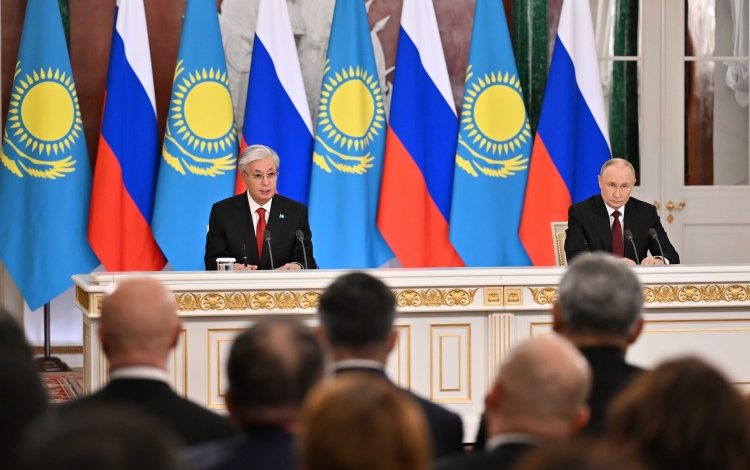
Moscow, November 12, 2025 — Kazakhstan and Russia have elevated their long-standing relationship to a new level, signing a declaration establishing a “Comprehensive Strategic Partnership and Alliance.” The agreement was inked at the Kremlin by Kazakh President Kassym-Jomart Tokayev and Russian President Vladimir Putin during Tokayev’s working visit to Moscow at Putin’s invitation.
In an op-ed for Rossiyskaya Gazeta ahead of the visit, Tokayev described the declaration as a milestone that “opens a new era in bilateral relations,” reflecting “an unprecedented level of mutual trust and readiness for closer cooperation.” Putin, for his part, called Kazakhstan “one of Russia’s closest allies,” saying the accord would strengthen regional coordination and border collaboration.
Expanding Economic and Energy Cooperation
Both leaders highlighted the rapid growth of bilateral trade, which reached nearly $30 billion in 2024 and continued to rise this year. Putin reaffirmed that Russia remains Kazakhstan’s largest trading and investment partner, while Tokayev emphasized plans to expand joint ventures in energy, manufacturing, and transportation.

Energy cooperation remains central to the partnership. The two presidents discussed increasing Russian gas supplies to Kazakhstan’s northern and eastern regions and reaffirmed plans to build Kazakhstan’s first nuclear power plant in cooperation with Russia’s state-owned Rosatom. They also pledged to coordinate oil and electricity policies and ensure the steady operation of the Caspian Pipeline Consortium, which transports Kazakh crude to the Black Sea via Russia.
Beyond energy, the leaders underscored growing collaboration in education and technology. Tokayev cited the opening of new Russian university branches in Kazakhstan as proof that bilateral cooperation extends “well beyond trade into science and culture.”
Long-Standing Ties and Regional Cooperation
Kazakhstan and Russia share a 7,600-kilometer border and maintain close economic and security ties through the Eurasian Economic Union and the Collective Security Treaty Organization. Their cooperation spans industrial development, infrastructure projects, and space exploration via the Baikonur Cosmodrome.
Tokayev described the alliance as “a natural continuation” of this enduring partnership. “Despite the complex international environment, cooperation between our nations continues to develop for the benefit of our peoples,” he said.
Balancing Global Partnerships
Tokayev’s Moscow visit followed an active period of diplomacy with other world powers. Just days earlier, he joined fellow Central Asian leaders at the White House for a C5+1 summit with U.S. President Donald Trump, marking a decade of U.S.–Central Asia engagement. The meeting produced new investment agreements and reaffirmed Washington’s interest in the region.
Earlier in 2025, Tokayev hosted Chinese President Xi Jinping in Astana during a China–Central Asia summit that celebrated record trade volumes and expanded cooperation in energy, logistics, and technology.
These parallel engagements reflect Kazakhstan’s signature “multi-vector” foreign policy—maintaining balanced relations with Russia, China, the United States, and Europe to diversify partnerships and avoid overreliance on any single power.
Neutral but Pragmatic on Global Conflicts
While reinforcing ties with Moscow, Tokayev continues to pursue a cautious stance on Russia’s war in Ukraine. He has reiterated that Kazakhstan “is not a mediator” but remains open to hosting peace talks “if both sides agree and genuine dialogue becomes possible.” The approach underscores Astana’s pragmatic neutrality—preserving ties with Russia while advocating respect for international law and peaceful resolution of conflicts.
Strategic Implications
For Moscow, the new alliance underscores that Russia retains committed partners despite global tensions. For Astana, it secures continued cooperation with its largest neighbor while keeping diplomatic flexibility to engage other powers. Analysts view the declaration as strengthening one pillar of Kazakhstan’s multi-vector diplomacy rather than redefining it.
In practical terms, the agreement is expected to accelerate joint energy and infrastructure projects and deepen coordination within Eurasian institutions. Symbolically, it reaffirms Kazakhstan’s role as both a reliable ally of Russia and an independent regional actor.
As the two leaders concluded their meetings, Putin accepted Tokayev’s invitation to make a state visit to Kazakhstan in 2026—capping a week that illustrated Tokayev’s guiding diplomatic principle: maintaining open channels with all partners while balancing global relationships through strategic pragmatism.