Turkmenistan and Spain Explore Regional Hub to Tackle Desertification in Central Asia

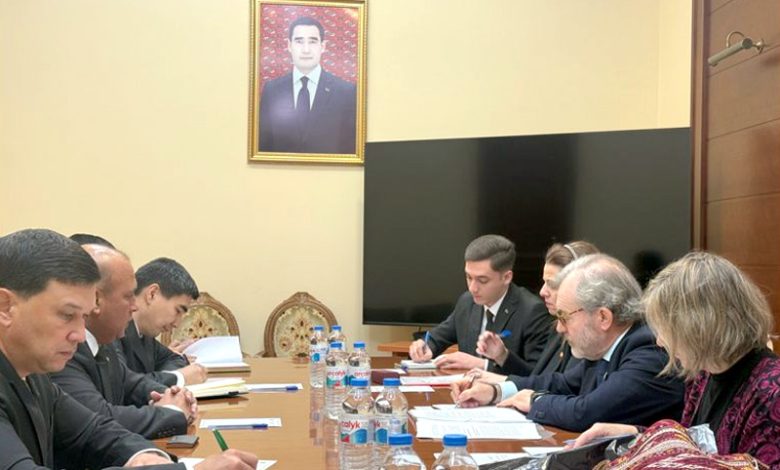
Turkmenistan and Spain have held talks on expanding cooperation to address desertification in Central Asia, including the potential establishment of a regional center dedicated to combating land degradation. The discussions took place in Ashgabat during a meeting between Turkmenistan’s Minister of Environmental Protection and Spain’s ambassador to Russia, Ricardo Martínez Vázquez, who is also accredited to Turkmenistan.
The talks followed Turkmen President Serdar Berdimuhamedov’s address to the United Nations General Assembly, where he proposed creating a specialized regional center to combat desertification in Central Asia. The initiative aims to deepen cooperation among regional states while attracting international expertise and funding.
Desertification poses a growing challenge across Central Asia, where arid and semi-arid landscapes dominate large parts of the region. Under the United Nations Convention to Combat Desertification (UNCCD), desertification is defined as land degradation in dry areas resulting from climatic variations and human activities. According to the UNCCD, more than 20% of land in Central Asia is already degraded, affecting roughly 30% of the population. Key drivers include unsustainable water use, intensive agriculture, overgrazing, and the long-term impacts of climate change.
Spain’s engagement on desertification in Turkmenistan reflects shared exposure to climate risks. As one of Europe’s countries most vulnerable to soil degradation, Spain co-founded the International Drought Resilience Alliance to promote expertise in dryland management and water conservation—experience that is directly relevant to Central Asia’s arid conditions. This common vulnerability has strengthened cooperation under the UNCCD framework, where countries exchange approaches to land restoration and drought resilience.

Beyond environmental cooperation, Spain views Turkmenistan as an emerging market for its engineering and agricultural technologies. Spanish companies such as TYPSA are already active in the region, providing technical support for large-scale infrastructure projects, including Caspian Sea desalination plants and the modernization of irrigation systems across vast tracts of farmland. Spain has also backed Turkmenistan’s proposal to host a Regional Center for Climate Change Technologies, envisioned as a platform for deploying Spanish green technologies in Central Asia.
This partnership aligns with the European Union’s broader Strategy for Central Asia, which emphasizes environmental stability as a pillar of regional security. Supporting Turkmenistan’s efforts to manage water scarcity and slow the advance of the Karakum Desert contributes to the EU’s Green Turkmenistan initiative, helping to curb resource-driven instability while strengthening trade links in a region of growing strategic importance.
One of the region’s most striking examples of desertification is the collapse of the Aral Sea. Once the world’s fourth-largest inland lake, it began shrinking rapidly in the 1960s after its feeder rivers were diverted for large-scale irrigation. By the early 2000s, the sea had lost about 90% of its volume, leaving behind the Aralkum desert, which now covers more than five million hectares. Dust storms from the exposed seabed spread salt and chemical residues across Central Asia, damaging agriculture and public health, with the World Bank estimating that tens of millions of tons of dust and sand are lifted annually.
Desertification is also advancing across steppe and pasturelands in Kazakhstan, Kyrgyzstan, Tajikistan, Turkmenistan, and Uzbekistan. Rising temperatures and more frequent droughts are accelerating soil moisture loss and erosion. The World Meteorological Organization’s State of the Climate in Asia 2024 report notes that Asia is warming nearly twice as fast as the global average, intensifying heatwaves, droughts, and other climate extremes.
In response, regional governments have launched mitigation initiatives. Kazakhstan and Uzbekistan have planted drought-resistant saxaul shrubs on the former Aral Sea bed to stabilize soils and reduce dust storms, while Kazakhstan has invested in partial restoration of the North Aral Sea, raising water levels and reviving some fisheries.
All five Central Asian states are parties to the UNCCD and have committed to achieving land degradation neutrality by 2030. Regional mechanisms, including the International Fund for Saving the Aral Sea, are working to coordinate responses and attract donor support. The proposed regional desertification center discussed by Turkmenistan and Spain would complement these efforts by providing a permanent platform for research, training, and policy coordination.
As climate pressures mount, officials see such initiatives as crucial to slowing the spread of deserts and protecting livelihoods across one of the world’s most environmentally stressed regions.