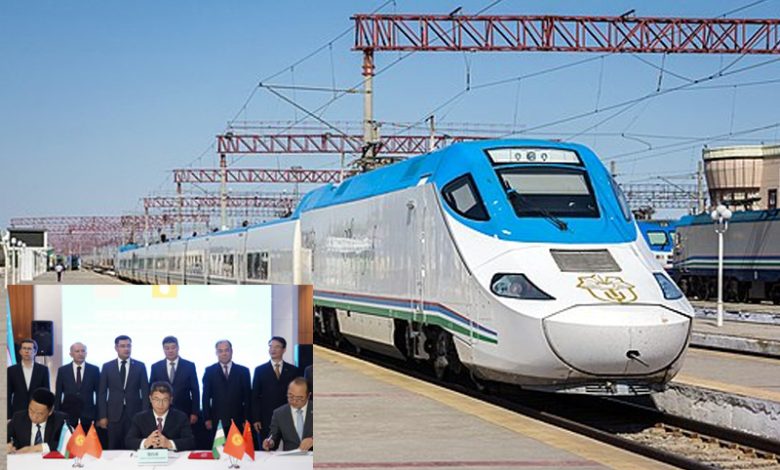
A loan agreement to finance construction of the China–Kyrgyzstan–Uzbekistan (CKU) railway was signed in Bishkek on December 16, marking a major step forward for one of Central Asia’s most ambitious transport projects. The Kyrgyz government said the agreement was concluded between China–Kyrgyzstan–Uzbekistan Railway Company LLC—a joint venture established by the three countries—and a syndicate of Chinese banks, including the China Development Bank and the Export-Import Bank of China.
The CKU railway has been under discussion for more than 20 years but was repeatedly delayed by disagreements over financing, routing, and technical standards. Progress accelerated after 2022, as China sought alternative westbound transport corridors and Central Asian states moved to diversify trade routes and reduce dependence on existing transit pathways.
The project’s total cost is estimated at $4.7 billion. Around $2.3 billion will be provided as a 35-year loan from China to the joint project company, which will be responsible for repayment. The remaining $2.3 billion will be contributed as authorized capital, with China holding a 51% stake and Kyrgyzstan and Uzbekistan each contributing 24.5%.
Spanning 523 kilometers, the CKU railway is a strategically important infrastructure initiative. Construction officially began on December 27, 2024, in Kyrgyzstan’s Jalal-Abad region. Once completed, the line will connect Kashgar in China with Torugart, Makmal, and Jalal-Abad in Kyrgyzstan, before extending to Andijan in Uzbekistan. Plans include a cargo transshipment station and logistics hub in Makmal, and the railway is expected to carry up to 15 million tons of freight annually.


Despite its strategic value, the project has sparked debate over potential debt risks, particularly for Kyrgyzstan, which already depends heavily on Chinese financing. Authorities argue that the joint-venture structure and long loan maturity will help limit fiscal exposure, while critics note that the project’s financial viability will depend on achieving projected cargo volumes.
At present, neither Kyrgyzstan nor Uzbekistan has a direct rail link to China; Kazakhstan remains the only Central Asian country with such a connection. Uzbek officials say the CKU railway will shorten transit times to Chinese markets and expand export opportunities for industrial and agricultural goods, potentially cutting delivery times by several days compared with existing routes.
Technically, the CKU railway is among the most complex projects ever undertaken in the region. It involves the construction of 50 bridges and 29 tunnels with a combined length of about 120 kilometers, meaning roughly 40% of the route will consist of tunnels and bridges. The Kyrgyz section alone will extend for 304 kilometers.
On December 5, Chairman of the Kyrgyz Cabinet of Ministers Adylbek Kasymaliev inspected construction progress at one of the tunnel sites in the Jalal-Abad region. Government sources said work is under way on 18 of the 29 tunnels and 17 of the 50 bridges, with 5,695 pieces of machinery and more than 5,000 workers currently involved.
For Kyrgyzstan, the CKU railway represents the largest infrastructure project in the country’s history. Officials see it as a transformative opportunity to position the country as a regional transit hub, generate employment and transit revenues, and deliver long-term economic benefits.
Once operational, the CKU railway is expected to integrate into wider transport networks linking China with Central Asia, the Middle East, and Europe, strengthening the region’s role as a key overland trade corridor amid shifting global trade dynamics.