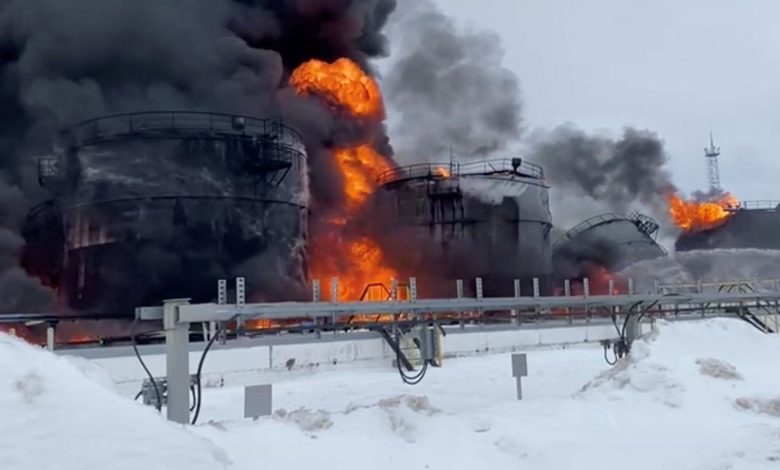
Tensions between Kazakhstan and Ukraine have intensified following a Ukrainian attack on oil infrastructure linked to the Russian Black Sea port of Novorossiysk. The strike, part of a broader Ukrainian campaign against Russian energy targets, caused notable damage and drew a sharp protest from Kazakhstan, which depends heavily on the port for exporting oil from its major fields to global markets. Ukraine, however, insisted the operation was aimed solely at undermining “full-scale Russian aggression,” not Kazakhstan, amid mounting worries over global oil prices and supply stability.
According to the Caspian Pipeline Consortium (CPC), “unmanned boats” struck a mooring device at its Novorossiysk marine terminal on Saturday, forcing a halt to loading and related operations. While there were no reported casualties and no immediate evidence of oil contamination in the Black Sea, several pipelines were shut, and the timeline for resuming normal shipments remains uncertain due to ongoing security threats.
“Shipments at the terminal will be carried out in accordance with established rules upon cancellation of threats from unmanned surface vessels and drones,” said the CPC, whose shareholders include companies from Russia, Kazakhstan, the United States, and multiple Western European states.
Kazakhstan has long tried to balance neutrality in the Russia-Ukraine conflict—maintaining strong diplomatic and commercial ties with Moscow while periodically expressing support for Ukrainian sovereignty. But the latest Ukrainian strike on Novorossiysk, targeting Russia’s oil infrastructure nationwide, prompted an unusually direct rebuke from Kazakhstan’s Ministry of Foreign Affairs.


“This incident marks the third act of aggression against an exclusively civilian facility whose operation is safeguarded by norms of international law. As a responsible participant of the global energy market, Kazakhstan consistently advocates for maintaining the stability and uninterrupted supply of energy resources,” the ministry stated.
“We view what has occurred as an action harming the bilateral relations of the Republic of Kazakhstan and Ukraine, and we expect the Ukrainian side to take effective measures to prevent similar incidents in the future,” it added.
Russia also condemned the attack. Foreign Ministry spokeswoman Maria Zakharova called it “terrorist,” noting that “our friends in the Kazakh Ministry of Foreign Affairs” had already issued a formal complaint.
Ukraine responded by acknowledging Kazakhstan’s concerns regarding the CPC infrastructure. “We emphasize that no actions by the Ukrainian side are directed against the Republic of Kazakhstan or other third parties – all efforts of Ukraine are focused on cutting off the full-scale Russian aggression within the framework of the right to self-defense guaranteed by Article 51 of the UN Charter,” Ukraine’s Ministry of Foreign Affairs said.
Ukraine also pointed out that Kazakhstan had not condemned Russian strikes on Ukrainian civilians, residential areas and energy facilities, including substations linked to nuclear power plants. Russia’s full-scale invasion of Ukraine began in February 2022.
The CPC emphasized that it is not subject to sanctions and plays a crucial role in “safeguarding the interests of the company’s Western shareholders.” The pipeline system transports crude from Kazakhstan’s major fields—Tengiz, Kashagan, and Karachaganak. In 2024, the consortium shipped roughly 63 million tons of oil, with about 74% belonging to foreign operators such as Tengizchevroil (Chevron), ExxonMobil, KazMunayGas, Eni, and Shell.