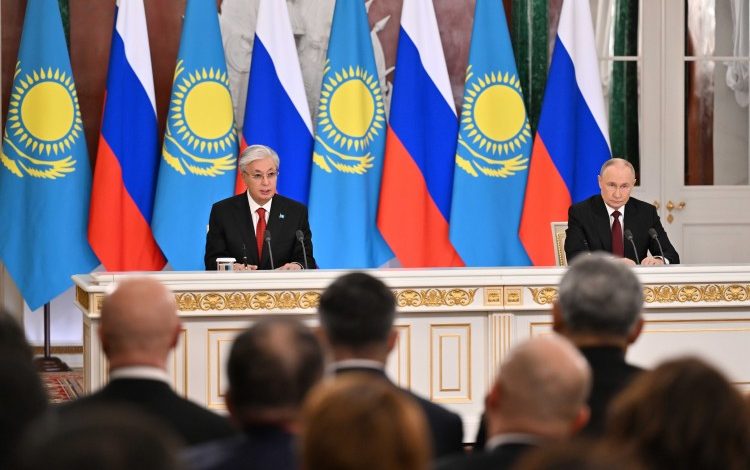
On November 12, 2025, Presidents Vladimir Putin and Kassym-Jomart Tokayev signed a declaration at the Kremlin elevating Russia–Kazakhstan relations to a comprehensive strategic partnership and alliance. The timing was notable: the agreement came almost immediately after Tokayev’s return from Washington, where the leaders of the five Central Asian states met U.S. President Donald Trump at the White House.
The Kazakh president’s U.S. visit appears to have fallen short of expectations. It underscored the geographical distance between the two countries and the limited commitments Washington was willing to offer. According to the author’s view, the United States largely focused on securing investments rather than providing meaningful security guarantees. Recent global events have also demonstrated that Washington is no longer prepared to shoulder the cost of protecting others or expanding its network of allies.
Concerns over China’s increasingly assertive policies also played a role in the decision to deepen ties with Moscow. In his remarks, President Putin called Kazakhstan and Russia “closest partners, friends, and reliable allies.” He highlighted that mutual trade exceeded $27 billion in 2024, matched by another $27 billion in investments. A major achievement, he noted, was the near-complete transition to national currencies in bilateral transactions.
President Tokayev echoed this sentiment, stressing that the strategic partnership and allied relationship between the two states “is not just a figure of speech or political courtesy, but the essence of our cooperation.” The leaders formalized this by signing the Declaration on Elevating Russia–Kazakhstan Relations to the Level of Comprehensive Strategic Partnership and Alliance.

Tokayev placed particular emphasis on nuclear energy cooperation, calling it “a breakthrough project” that would not only involve building a nuclear power plant but also creating an entirely new field of domestic expertise. He noted that bilateral trade is nearing $30 billion and that 1,703 joint projects now involve investments exceeding $50 billion.
The declaration prioritizes the development of an equal and indivisible Eurasian security architecture, assigning key roles to the Collective Security Treaty Organization (CSTO), the Commonwealth of Independent States (CIS), the Shanghai Cooperation Organization (SCO), and the Conference on Interaction and Confidence-Building Measures in Asia (CICA).
According to the signed document, the two sides reaffirmed the CSTO’s central role in regional stability. Acknowledging the growing authority of the Eurasian Economic Union (EAEU), they also committed to expanding common markets under the 2014 EAEU Treaty and boosting competitiveness across their national economies. The CIS was recognized as an important platform for broad cooperation.
Given the world’s longest continuous land border between the two countries, the declaration underscores interregional and cross-border engagement as a unique instrument for strengthening bilateral ties.
A key part of the document focuses on financial cooperation, particularly the continued expansion of national currency use in mutual settlements. Another major priority is the creation of a unified Eurasian transport and logistics system to enhance regional connectivity and diversify cargo flows through more reliable, safe, and efficient supply chains. Special attention will be paid to increasing the capacity of the International North–South Transport Corridor and linking it with regional routes.
To improve transport links, both sides will advance new and modernized corridors, including the “Western Europe – Western China” route, and cooperate within the “Trans-Altai Dialogue,” which aims to unlock the economic potential of the broader Altai region.
A significant section of the declaration emphasizes preserving shared historical memory. As the 80th anniversary of Victory in the Great Patriotic War approaches, both sides will intensify joint historical research and commemorate the contribution of Soviet peoples to defeating Nazism. The education system is identified as crucial for fostering an objective understanding of this shared past among future generations.
The two parties also reaffirmed commitments to improve conditions for each other’s citizens, underscoring constructive cooperation on migration. Welcoming the establishment of the International Organization for the Russian Language, they voiced strong support for its activities and encouraged other states to join. Kazakhstan underscored its support for promoting the Russian language as a tool of interstate communication within the CIS. Cooperation in education, workforce training, and scientific dialogue is expected to deepen further.
Cultural and humanitarian relations are described as a valuable asset built on mutual respect for cultural diversity. Dialogue will be encouraged to strengthen understanding of the traditions, histories, and cultures of the two “fraternal peoples,” promoting mutual enrichment grounded in shared spiritual and moral values, the civilizational unity of Slavs and Turks, the brotherhood of “Ancient Rus and the Great Steppe,” and the union of Orthodoxy and traditional Islam.
Reflecting on the broader implications, the author argues that the document demonstrates Moscow’s significant progress in reinforcing its position in Kazakhstan, Central Asia’s largest state. Beyond military and economic gains, Russia has strengthened the status of the Russian language, which had been receding across much of the post-Soviet region. The CSTO’s enhanced prominence in ensuring regional stability similarly serves Russia’s interests, given its dominant military and economic influence within the organization.
The article concludes that the geopolitical contest for Central Asia is entering a new stage—and that the momentum of global political change, long centered in the West, is now gradually moving eastward.