The Jewel Beneath Bukhara’s Sands: The Enduring Legacy of the Ismail Samani Mausoleum
By Zebiniso Niyazova

BUKHARA, Uzbekistan
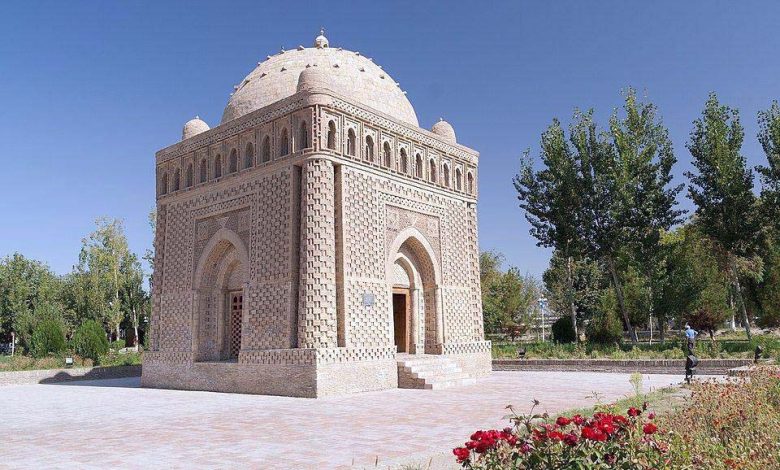
Amid the ancient charm of Bukhara, one monument stands as a timeless testament to the city’s architectural brilliance and spiritual grandeur — the Mausoleum of Ismail Samani, often hailed as the eighth wonder of the world. Preserved for over a millennium beneath layers of history and sand, the mausoleum remains a shining symbol of Central Asia’s cultural and artistic heritage.

Constructed in the 9th–10th centuries under the rule of Ismail Samani, founder of the Samanid dynasty, the mausoleum exemplifies a rare fusion of mathematical precision, artistic symmetry, and spiritual symbolism. Measuring 10.8 by 10.7 meters on the outside with walls 1.8 meters thick, the square-shaped structure is adorned with intricate brickwork that reflects harmony between geometry and divinity.
At each corner, column-like supports rise to strengthen the edifice, while four smaller domes encircle the central dome — symbolizing the four directions of the world. The monument’s forty small windows filter sunlight into the chamber, creating a mystical interplay of light and shadow that changes hues throughout the day.


Historians note that the mausoleum once served as the family tomb of the Samanids, housing the remains of Ismail Samani, his son, and grandson. Beyond its architectural beauty, the building reflects the Samanid dynasty’s intellectual depth and devotion to balance — where every brick, arch, and pattern embodies the mathematical and philosophical sophistication of early Islamic art.
Buried to Be Saved
The mausoleum’s survival through the centuries is a story of courage and ingenuity. In 1220, when Genghis Khan’s army invaded Bukhara, the city faced near-total destruction. To protect their cherished monument, the people of Bukhara covered the mausoleum with sand, disguising it as a natural mound. The Mongol forces, mistaking it for a hill, left it untouched.
For centuries, the jewel of Bukhara lay hidden beneath the sands until it was rediscovered and gradually restored to its former splendor.

Revival of a Masterpiece
In the early 20th century, restoration efforts revived the monument. In 1925, the dome underwent repair, followed by archaeological excavations in 1927 led by Professor Muso Saidjanov and V. Vyatkin. Under the guidance of B. Zasipkin and the skilled craftsman Usta Shirin Murodov, the mausoleum was meticulously restored — its structure strengthened, its artistry renewed.
Today, the Mausoleum of Ismail Samani stands as the heart of Samanid Park of Culture and Recreation, drawing visitors and scholars from around the world. Its brickwork, illuminated by sunlight and moonlight, continues to dazzle with hues that shift seven times a day — a living symbol of the eternal rhythm of time.

A Monument Beyond Price
The mausoleum’s beauty has inspired admiration and awe across generations. Legend has it that an American tourist once offered to exchange the monument for its weight in gold. The guard’s reply was firm and poetic: “Even if all the world’s millionaires gathered their wealth, they could not buy it.”
Indeed, the Mausoleum of Ismail Samani is not merely an architectural wonder — it is Bukhara’s soul preserved in brick and light, a reminder of the city’s golden age and the enduring wisdom of its ancestors.
Every shadow cast by its arches, every curve of its dome, and every carved brick tells a story — a story of intellect, resilience, and devotion that has outlasted empires and centuries.