Kazakhstan Delegate at COP30 Highlights Challenges and Value of Global Climate Cooperation

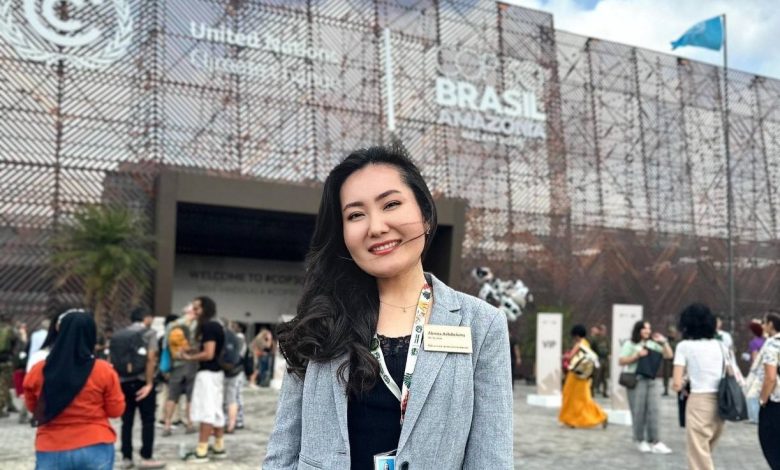
Belém, Brazil — Almira Azhibekova, a member of Kazakhstan’s delegation to the COP30 climate summit in Brazil and a Master of Environmental Management student at Yale University, says the annual negotiations remain difficult but indispensable for advancing global climate action.
Representing Kazakhstan’s Ministry of Ecology and Natural Resources, Azhibekova assisted with negotiations analysis and preparation of final reports. Speaking to The Times of Central Asia, she described the conference as a rare opportunity to connect her academic training with real-world climate diplomacy.
According to Azhibekova, witnessing the negotiations firsthand revealed both the urgency and complexity of international decision-making. “Reaching consensus is not easy,” she said, noting that each country enters talks with its own priorities and constraints. Even a single paragraph of a final agreement can require multiple rounds of consultations in informal groups, working sessions, and plenary meetings. “Sometimes one sentence is debated for hours,” she added.
She emphasized that small differences in wording often become central points of contention because terminology in international climate law carries precise legal and operational implications. “A slight change in phrasing can determine how a mechanism is implemented,” she said, underscoring the power of language in shaping global climate policy.

Beyond the negotiating halls, Azhibekova observed a range of practical challenges affecting cooperation, including disparities in language abilities, technical expertise, national experiences, and delegation sizes. Some countries, she noted, struggle to send enough representatives to cover parallel discussions, raising concerns about equity and participation.
The broader impact of climate policy was also evident. “Climate change affects every aspect of economies and societies,” she said. “Decisions made here influence development, security, and international relations far beyond the environmental sphere.”
One highlight of her experience was a meeting with Dr. Katia Simeonova, a key architect of the Paris Agreement’s transparency framework. Azhibekova said Simeonova’s insights into negotiation strategy and textual interpretation deepened her understanding of how countries advance their national priorities. The exchange, she added, strengthened her commitment to contributing to Kazakhstan’s climate efforts.
Azhibekova expressed gratitude to Brazil for hosting COP30 and acknowledged that, despite limitations, the summit remains a vital platform for cooperation. “The system is imperfect and needs improvement to translate discussion into action,” she said. “But COP is where essential decisions begin — and where today’s voices speak for future generations.”