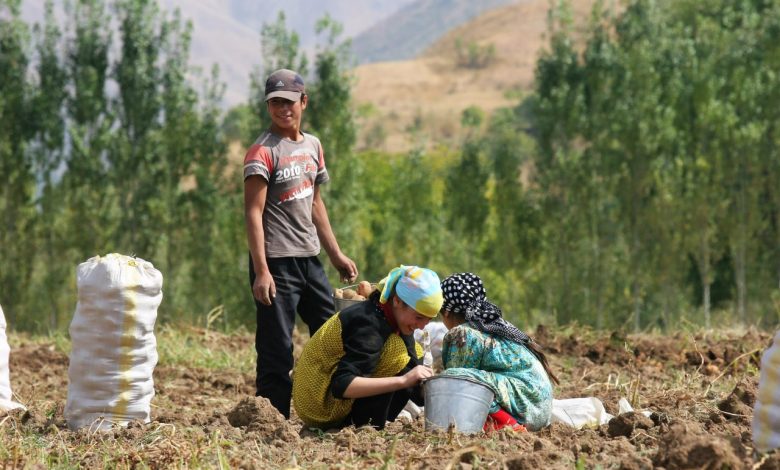
Tajikistan remains one of the world’s most climate-exposed countries, with rising temperatures and extreme weather increasingly disrupting daily life, health, livelihoods, and food security. Between 1992 and 2016, natural disasters affected more than 80% of the population and caused economic losses of $1.8 billion. Now, worsening climate impacts are hitting agriculture especially hard, intensifying problems for rural communities.
Farmers Struggle as Extreme Weather Cuts Yields
Farmer Bahodur Khaitov says abnormal winter cold this year killed most of his grape trees, while intense summer heat damaged tomatoes, cucumbers, and rice. “I used to get 7–8 tons of rice from one hectare. In the last two years, the yield has fallen to 5 tons,” he said. Crops such as tomatoes, cucumbers, potatoes, peppers, and cabbage have become highly vulnerable.
Traditionally, these vegetables were grown in summer and sold fresh in early autumn. “Since 2019, because of the heat, it’s impossible to grow them in summer,” Khaitov added.


Late watermelons—once a popular September crop grown on rain-fed lands—have also been affected. For the third year in a row, farmers have been unable to produce them. Veteran grower Mumin Safarov said his entire crop dried up. “Because of the heat, the humidity has gone deep into the soil. Growing rain-fed watermelons is simple, but as you can see, there is no harvest,” he lamented.
Producers warn that Tajikistan is not adapting quickly enough to changing conditions. Days are increasingly hot and dry, while early-morning dew in August can destroy delicate crops like cucumbers. When the sun rises, the evaporating dew burns leaves, triggers diseases, and attracts pests—leaving farmers with small harvests that don’t cover production costs. As a result, many now grow crops earlier and under polyethylene to avoid August losses.
Scientific Warnings: Rising Heat, Degrading Land, and Stressed Livestock
According to agricultural scientist Kurbonali Partoev, climate change is increasing irrigation needs, accelerating land degradation, and raising crop losses. He warns that extreme heat and unpredictable weather also heighten the risks of harmful insects, pathogens, fungi, and weeds. In livestock farming, heat shocks can drive up illness and mortality.
Agricultural specialists add that extreme heat leaves plants exhausted. Dry air increases water evaporation from leaves, slowing photosynthesis and contributing to broader warming. “Plants simply don’t have time to swallow carbon dioxide,” one expert noted.
Temperatures Continue to Climb
President Emomali Rahmon has repeatedly warned of climate pressures. Speaking at the “Water for Sustainable Development 2018–2028” conference, he said: “Long-term observations indicate an increased impact of climate change on nature and the socio-economic situation in Tajikistan and Central Asia.” Over the past 60 years, the average annual air temperature in Tajikistan has risen by one degree Celsius, while natural hydrometeorological events have increased in frequency and intensity.
Asian Development Bank (ADB) experts predict temperatures in Tajikistan—especially in flat areas—will increasingly exceed 40°C, worsening health risks. By 2090, national warming could reach 5.5°C above 1986–2005 levels, far above global averages.
What Can Be Done?
ADB experts warn that without significant adaptation measures and reduced disaster risks, rising heat and drought will cause severe losses. In agriculture, priorities must include diversifying livelihoods, improving water and land management, and expanding climate-resilient practices.
One of Tajikistan’s most critical adaptation strategies is large-scale tree planting. “Trees produce oxygen, purify air, regulate temperature, stabilize soil, retain water, and control floods—not to mention the benefits of food, fuel, and beauty,” said Shanny Campbell, ADB Country Director in Tajikistan.
As the Asia-Pacific Climate Bank, the ADB is working with governments and partners to mobilize new climate finance and support advanced climate-resilience knowledge. The bank recently announced the Innovative Climate Finance Mechanism for the Asia-Pacific Region (ICFM-APR), described as “a landmark program” to scale up climate support.
The mechanism uses a “$1 in, $5 out” model: an initial $3 billion in guarantees could unlock up to $15 billion in new financing for climate projects across the region. ADB says this mechanism supports its broader goal of providing $100 billion in climate financing by 2030, including $34 billion dedicated to climate adaptation.