Pulled from Classrooms to Cotton Fields: Forced Labor Persists Across Central Asia

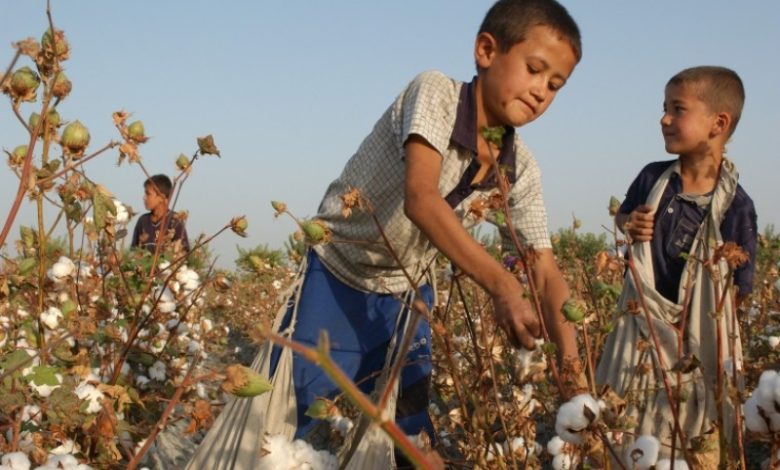
In a small village in northern Tajikistan’s Sughd region, Hurmatoi, a community nurse, spends her days giving injections, checking blood pressure, and visiting bedridden patients. But this harvest season, she’s far from her patients — she’s in the cotton fields.
“Last week, several dozen of us from public offices were sent to pick cotton,” she told RFE/RL, asking not to use her full name for fear of retaliation. “We brought folding beds, slept in makeshift dorms, and worked from sunrise to sunset with just a short break for lunch.”
Cotton remains a cornerstone of Central Asia’s rural economies. Uzbekistan produces about 1.3 million tons a year, followed by Turkmenistan with 800,000 tons and Tajikistan with roughly 500,000 tons. But this wealth is often built on the backs of teachers, nurses, students, and civil servants who are pressed into the fields every autumn.
Hospitals and Schools Left Empty

Across Tajikistan, Turkmenistan, and Uzbekistan, thousands of public employees have been mobilized for cotton-picking duty, leaving hospitals, schools, and government offices short-staffed during the harvest season from late August through November.
Workers and rights groups say the practice amounts to forced labor, with threats of dismissal, disciplinary action, or expulsion used to ensure participation. Those who can afford it often bribe officials or hire replacements to avoid the backbreaking work. In Tajikistan and Turkmenistan, those unable to work must still pay for a substitute picker.
Though rights groups say the practice has declined under international scrutiny, Hurmatoi’s story — and many others — show that coercion continues.
“The cost of meals — breakfast, lunch, and dinner — is deducted from our pay,” she said. “By the end, there’s barely any money left. I’m 48, I have back pain, but if I refuse, I’ll lose my job.”
‘Voluntary’ Labor Under Pressure
Authorities maintain that cotton-picking is voluntary. Yet evidence suggests otherwise.
In Tajikistan’s Khatlon region, education officials have ordered teachers and students to work in the fields “in their free time.” In Uzbekistan, teachers, nurses, and local officials in several provinces said they were pressured to join so-called ‘voluntary’ harvest drives organized by local administrations.
“All our school employees — teachers, guards, and administrative staff — are in the fields,” a teacher in Uzbekistan’s Bukhara region told RFE/RL. “We were instructed that if anyone asks, we must say we came of our own free will.”
Uzbek President Shavkat Mirziyoyev, who took power in 2016, promised to eliminate forced and child labor following boycotts by major Western brands such as H&M, Nike, and Walmart. While international monitors once hailed progress, reports this year point to a resurgence of forced mobilization under new terms like “voluntary participation.”
On September 26, Mirziyoyev declared a 10-day “emergency campaign” to speed up harvesting. Uzbekistan planted cotton on 875,000 hectares this year, targeting 3.7 million tons of raw cotton in 2025.
Official Crackdown amid Renewed Abuse
Facing global scrutiny, Uzbek authorities remain defensive. On October 14, the Employment Ministry said it had identified over 70 labor law violations and reiterated that “all forms of forced labor are strictly prohibited.” Several local officials have been fined, including a deputy district governor in Surkhondaryo Province, who was ordered to pay 20.6 million soms ($1,720) for threatening and insulting local residents who refused to join the harvest.
In Turkmenistan, the state’s involvement is even more overt. The government openly backs mass labor mobilization, sending farmers, civil servants, soldiers, former prisoners, and even alimony defaulters to the fields.
“Unlike previous years, many workers are now told to pick cotton for free,” said a resident of the Balkan province, speaking anonymously. “Officials tell us, ‘You receive your salary from the state — this is your duty.’”
A Broken System
Experts say the persistence of forced labor stems from the unreformed structure of the cotton economy.
“The cotton sector in these countries remains fundamentally unreformed,” said Alisher Ilkhamov, director of the UK-based research group Central Asia Due Diligence. “Mirziyoyev’s reforms were political — they paused mass mobilization for a while — but the centralized system remains. As long as the government sets quotas and prices, local authorities will keep forcing people to meet them.”
A Dushanbe-based economist, who declined to be named, said real reform must start with economics, not coercion.
“Sending students and state workers to the fields while calling it voluntary isn’t a solution,” he said. “If the government paid fair wages to pickers and farmers — who currently receive little because the state takes most of the profit — people would join willingly.”
At a Glance: The Cotton Paradox in Central Asia
- Countries involved: Uzbekistan, Tajikistan, Turkmenistan
- Workers affected: Thousands of teachers, nurses, students, and civil servants
- Harvest season: August–November
- Output: Over 2.6 million tons annually across the three countries
- Main issue: Persistent forced labor under “voluntary” labels
Solution: Higher payments and structural reform of the state-controlled cotton system