US Diplomats Lay Groundwork for High-Stakes Central Asia Summit in Washington


Two senior American diplomats are wrapping up a four-day mission across Central Asia, laying the foundation for the upcoming US–Central Asia summit set for early November in Washington.
Special Envoy for South and Central Asia Sergio Gor and Deputy Secretary of State Christopher Landau described their meetings in Uzbekistan as “productive” as they worked to finalize the summit agenda. During their October 27 visit, they held talks with Uzbek President Shavkat Mirziyoyev, his daughter and chief of staff Saida Mirziyoyeva, and the ministers for mining, investment, and trade.
According to official readouts, discussions focused on key themes to be addressed at the November 6 summit, which will convene under the C5+1 format. While observers see Washington’s growing engagement as driven largely by interest in Central Asia’s critical minerals, Mirziyoyev’s office stressed a broader agenda—emphasizing “advancing projects in industry, finance, energy, digitalization, agriculture, and other priority areas.”
Uzbek Trade and Investment Minister Laziz Kudratov highlighted the importance of “practical implementation of reached agreements,” citing mining, agriculture, transportation, and information technology as top sectors for cooperation.

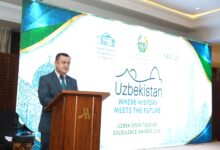
Following their meetings in Tashkent, Gor and Landau traveled late on October 27 to Kazakhstan, where they were set to hold talks with government officials and business leaders. Like Uzbekistan, Kazakhstan aims to push forward a wide-ranging agenda, including securing US support to address the shrinking Caspian Sea—an environmental issue threatening the Middle Corridor trade route.
On October 26, Kazakh President Kassym-Jomart Tokayev even proposed inviting Azerbaijani President Ilham Aliyev to join the Washington summit. Although Azerbaijan lies outside Central Asia and the C5+1 grouping, it shares the Caspian coastline and serves as a key link in the Middle Corridor network. Kazakhstan, Uzbekistan, and Azerbaijan are also collaborating on major trans-Caspian infrastructure projects, including a power line and fiber-optic cable that will strengthen regional connectivity.